
When a parent calls me about autism testing, they often don’t know what to expect or even what to ask. When I explain the process, many parents are surprised that it can take several hours and that I’ll request information from their child’s school.
I understand why. That’s not how most medical testing works. For example, you get a blood draw, the lab runs the test, and a number comes back.
An autism evaluation is very different.
We don’t yet have the ability to use these types of medical tests to determine whether a child has autism. Instead, you see a psychologist who collects information from multiple sources, and this takes time.
Much of that information involves social behavior, and social behavior can be messy and difficult to measure. Not only that, but certain behaviors can look like (or sometimes be explained by more than one) condition, such as anxiety.
For example, how do we know whether someone is avoiding eye contact because of autism, anxiety, or a cultural preference?
This is one of the reasons an evaluation takes several hours across more than one visit. A single data point simply can’t answer the question reliably.
Here’s what the process actually looks like in my practice and, just as importantly, what it doesn’t include.
What It Involves
A Detailed Developmental History
We start with your child’s history: early milestones, first words, how they played as a toddler, friendships over the years, sensory sensitivities, sleep, eating, and any periods of regression.
Parents sometimes apologize for how much they’re telling me. Other times, they summarize or skim over details, perhaps thinking certain things aren’t important enough to mention.
But the history is often where the pattern first becomes visible.
Autism Testing
I most frequently use the ADOS-2.
The Autism Diagnostic Observation Schedule, Second Edition (ADOS-2), is considered a reference-standard observational assessment for autism (Lord et al., 2012).
It isn’t a questionnaire.
Sometimes parents might think, “But she’s just playing with my child. When does the actual autism test start?”
This is it!
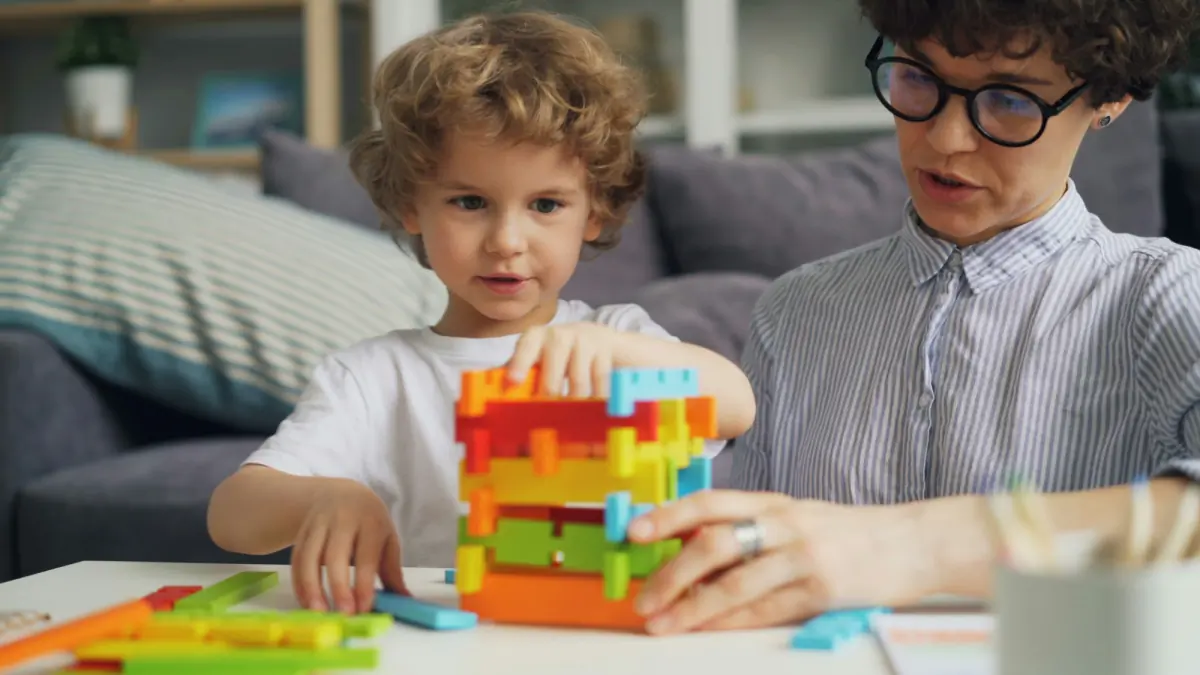
The ADOS-2 is a structured, play-based interaction with activities and conversations matched to your child’s age and language level. It allows me to observe social communication directly.
Parent questionnaires and interviews tell me what you see at home. The ADOS-2 shows me what happens in a standardized social situation.
Cognitive and Adaptive Testing
While autism is diagnosed based on behavior, I may sometimes assess your child’s IQ or cognitive abilities.
I don’t always administer an IQ or cognitive test, but you may see me choose one for your child depending on the questions we’re trying to answer.
Cognitive testing helps us understand how your child thinks and learns.
Adaptive testing is a bit different.
I always include an adaptive assessment because one important question it helps answer is: How is your child functioning in everyday life?
For example, your child might have some differences in their social skills, but their overall daily functioning may be where we would expect it to be. Or vice versa.
Adaptive testing is usually completed through a parent questionnaire.
This is because so many adaptive behaviors are things you would observe at home or in the community, settings that I, as the clinician, don’t typically have access to.
When I talk about measuring adaptive skills, I’m referring to what your child can actually do day to day: communicating their needs, managing self-care, and navigating social situations.
School Records and Teacher Input
Report cards, teacher comments, and any prior school assessments are also helpful sources of information that I’ll want to review whenever possible.
Teachers see your child in one of the most socially demanding environments they face daily, and their observations carry weight.
As someone who trained in schools, I can’t stress enough the value of being able to observe a child among their peers.
Schools give us opportunities to see what is typically expected socially and what might be different. Teachers and other educational providers see how children respond to your child in real time and how your child engages (or doesn’t engage) with their peers.
This is rich information, and teachers and other educational providers can often offer an important piece of the puzzle.
Sometimes, in my more complex cases, I may even ask whether you’d be comfortable with me visiting your child’s school so I can observe them in their everyday environment.
A Medical and Developmental Screen
This comes up early in the process, during intake.
I’ll want to know about your child’s medical history, including hearing and vision, any prior diagnoses, and family history.
This is important because several conditions can mimic or mask autism, and considering or ruling out alternative explanations is part of the evaluation process.
If you’re reading this before seeking an evaluation, I recommend making sure your child has had recent hearing and vision screenings.
Differential Diagnosis, Done Properly
As I mentioned earlier, ADHD, anxiety, language disorders, and intellectual disability can all look like autism or co-occur with it.
Sorting that out is the entire point of a comprehensive evaluation rather than relying on a checklist.
I never diagnose based on a single test score. The diagnosis has to hold up across the different sources of information.
A Feedback Session and a Written Report
After testing is complete, we sit down together, and I walk you through what I found.
In plain language.
The written report follows within two weeks.
It’s written to be useful: to you, to your child’s school, and to any provider who needs to understand your child.
I welcome questions, and I mean ANY questions, about the evaluation.
Why did I use a certain test or tool and not another? How did I come to my conclusions? Which differential diagnoses did I consider, and which did I ultimately rule in or out?
We also talk about recommendations and next steps.
And recommendations are really the whole point of the assessment!
I might need to write an article just about that. ;)
What It Doesn’t Involve
A 20-Minute Screening
Questionnaires like the M-CHAT or the AQ are screening tools.
They flag potential concerns and can be very helpful to complete before investing time and resources in a full evaluation.
But they aren’t diagnostic tools on their own.
A Guaranteed Diagnosis
This surprises people, but it’s one of the most important things I can say:
A good evaluation may show that autism doesn’t fit.
When that happens, the same process often helps us understand what might better explain your child’s experiences and behaviors.
And that’s just as valuable.
You came looking for answers, and the goal is to provide meaningful information either way.
That may not always mean receiving a diagnosis, but I may still be able to offer insight into your child’s functioning, their current environment, and what kinds of supports or changes could help.
A Promised School Outcome
The evaluation provides information. It doesn’t make school eligibility decisions.
If your child needs school services, the IEP team determines eligibility.
My report provides information and evidence that can help the team make informed decisions.
Conclusion
An autism evaluation is sometimes slower and more thorough than most parents expect, and that’s intentional.
You’re not investing these resources and time just for a test or a diagnosis.
You’re investing in a process where a psychologist gathers and carefully considers every relevant, available piece of information about your child and tells you, honestly, what it all adds up to.
I conduct comprehensive autism evaluations for children, teens, and young adults in Sacramento, with no waitlist.
Book a complimentary 15-minute consultation to talk through whether an evaluation makes sense for your family.
Book a Complimentary ConsultationReferences and Further Reading
Lord, C., Rutter, M., DiLavore, P. C., Risi, S., Gotham, K., & Bishop, S. L. (2012). Autism Diagnostic Observation Schedule, Second Edition (ADOS-2) manual (Part I): Modules 1-4. Western Psychological Services.
Getting started
Every evaluation begins with a consultation call.
Avenir serves families in Sacramento, Roseville, Davis, Elk Grove, Folsom, Woodland, the Bay Area, and Northern California.
Reminder: This practice does not accept insurance.Read more
Your out-of-pocket fee is:
Comprehensive developmental / psychological evaluations
- Ages 0–3$2,500
- Ages 4–5$3,000
- Ages 6 and up$4,000
Psychoeducational assessment
- Ages 7 and up$5,000
See the Fees page for more information about fees, payment, and insurance.